

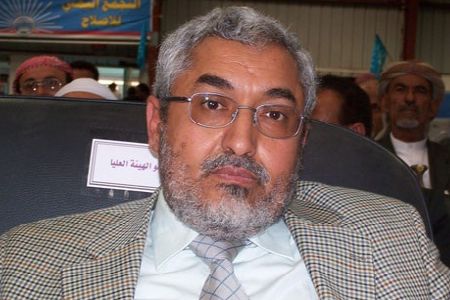
Yemen: Rights Radar Rejects Manipulation of Qahtan’s Case and Calls for an International Investigation to End the Uncertainty Surrounding His Fate The Hague, May 12, 2026 Rights Radar for Human Rights, based in The Hague, the Netherlands, has called on the UN Special Envoy to Yemen, Hans Grundberg, to use his mandate to exert maximum pressure to uncover the fate of prominent Yemeni politician Mohammed Qahtan, who has been forcibly disappeared by the Houthi militia for the past eleven years. It is deeply regrettable that eleven years have passed since his abduction from his home in Sana’a and subsequent enforced disappearance. His uncertain fate continues to be used as a form of psychological torture against his family and children, while the UN envoy remains unable to determine his place of detention or even confirm whether he is alive. As talks and consultations continue regarding the exchange of prisoners and detainees, it is hoped that these efforts will lead to the disclosure of Qahtan’s fate and his immediate release. He must be returned safely to his family, restored to the life he was taken from on April 4, 2015. The Houthi militia’s continued concealment of the fate of a prominent political figure like Qahtan is unacceptable. Using his case as a tool of political blackmail, despite repeated appeals and clear moral and legal obligations, is a grave violation that must end with his immediate release. The Houthi militia’s claim that Mohammed Qahtan died or was killed in an airstrike in 2015 is completely contradicted by undeniable facts and evidence. Most notably, the Houthi-affiliated Specialized Criminal Prosecution issued a memorandum to its Political Security Bureau on February 5, 2019, ordering Qahtan’s release. This memorandum directly refutes the Houthi narrative alleging that he died in April 2015. The same memorandum also referenced a criminal case filed against Qahtan on November 11, 2015, approximately seven months after his alleged death. This effectively constitutes an official Houthi acknowledgment of his continued existence and, consequently, underscores their responsibility for his safety and fate. The international community, particularly the United Nations Security Council, which included Mohammed Qahtan in United Nations Security Council Resolution 2216, bears a direct or indirect responsibility to hold the Houthi militia accountable for Qahtan’s safety and release. In this context, we emphasize the necessity of establishing an independent international commission of inquiry to uncover all the circumstances surrounding his detention and enforced disappearance and to determine the full truth about his fate. This is essential to establish legal responsibility for all that he has endured and to ensure accountability for the crime of enforced disappearance and the manipulation of his fate, which constitutes a form of psychological torture for all concerned parties, especially his family. We share the family’s skepticism regarding Houthi claims that he was killed in an airstrike in 2015, as these assertions are directly contradicted by available facts and evidence. Notably, the family has stated that the late Major General Abdul Qader Hilal had assured them of Qahtan’s safety until Hilal himself was killed in a coalition airstrike in what became known as the Grand Hall incident in Sana’a on October 8, 2016. Furthermore, multiple consistent testimonies indicate that Qahtan was alive and well after 2020—a period during which coalition airstrikes on Sana’a had already ceased. These testimonies include statements attributed to Major General Faisal Rajab, a former Houthi detainee who, along with Qahtan and others, was included in the United Nations Security Council Resolution 2216 calling for their release, as well as other accounts affirming that Qahtan remains alive. Furthermore, statements made by the Houthi negotiating team during the rounds of talks that secured the release of Mahmoud al-Subaihi, Faisal Rajab, and Nasser Mansour Hadi explicitly indicated that Mohammed Qahtan would be included in the subsequent phase. This admission strongly implies he remains in their custody and is alive, directly contradicting their recent assertions that he has deceased. Therefore, the Houthi militia bears full and direct responsibility for the health and safety of Mohammed Qahtan and is legally and morally obligated to comply with applicable domestic and international law to ensure his immediate release. We believe it is important to consider the testimony of Qahtan’s political associate and brother-in-law, Jamil al-Qubaisi, who was abducted at the same time and later released through local mediation and guarantees. This testimony may be relied upon and further examined in any investigation into the case. Al-Qubaisi also recounted a 2023 meeting with an individual linked to the Houthi leadership in Khawlan al-Tayyal district in the north of Yemen. According to his account, the individual stated that “Mohammed Qahtan is well” and expressed readiness to provide proof, provided that the legitimate government authorities in Ma’rib release his brother. Al-Qubaisi also cited a 2022 meeting with a Houthi leader known to him. During this encounter, the leader claimed to have seen Mohammed Qahtan in person in 2021 at a villa, though he did not specify its exact location. Prior to that, in 2020, he reported that investigators at the Political Security Prison in Sana’a told him that “Mohammed Qahtan is well and in good health,” and that they could allow him to verify this. Given this information, there is strong evidence suggesting that Mohammed Qahtan is alive and being held by the Houthis. This reinforces the urgent need for sustained international pressure to establish an independent investigative committee capable of uncovering all circumstances and revealing the full truth. Based on the above information, data, and testimonies, this case reflects compounded violations against the abductee Mohammed Qahtan, as well as a challenging situation that extends beyond the local context to the international level. This includes the circumstances of his abduction, subsequent detention, and prolonged enforced disappearance over many consecutive years, alongside the deliberate manipulation of his fate and his use as a tool for political blackmail and psychological pressure against his family and relatives. These actions represent a grave violation of established Yemeni norms and of national and international laws that criminalize abduction and enforced disappearance, and that require the protection of fundamental human rights, including the right to psychological and physical safety, as well as the basic right to communicate and maintain contact with family members.
12
May
2026

Comments 0