
The Hague, September 21, 2026
Rights Radar Organization for Human Rights, based in The Hague, Netherlands, has called on the conflicting parties in Yemen to avoid targeting civilians, populated areas, and civilian objects during any confrontations or clashes that could endanger lives and property across the country’s governorates and districts.
Rights Radar has emphasized the importance of respecting both national legislation and international law, which prohibit and criminalize human rights violations under all circumstances, as well as the need to adhere to the rules of engagement governing the protection of civilians.
The organization stated that targeting civilian objects, together with the excessive use of indiscriminate shelling and direct sniper fire, constitutes a serious violation of international humanitarian law and the four Geneva Conventions. Such actions, it noted, require urgent international intervention to ensure that those responsible are held accountable and that civilians receive legal and humanitarian protection.
Rights Radar explained that its field monitoring team had documented numerous violations during the ongoing military escalation between the Houthi militia and the internationally recognized government across various Yemeni districts and governorates, most notably in the Al-Mokha and other areas along Yemen’s West Coast.
The organization noted that the violations documented during the current escalation occurred across six Yemeni governorates and included killings, injuries, arbitrary arrests, abductions, and forced recruitment, in addition to attacks on public and private property.
It reported documenting 242 cases of grave violations against civilians—particularly women and children—as well as against private property and civilian objects. All these violations were committed by members of the Houthi militia during recent military developments and clashes in and around Al-Mokha and along the West Coast, reaching the governorates of Al-Hodeidah and Taiz, as well as several other governorates.
Rights Radar also confirmed that these violations resulted in, at least, 93 civilian casualties, killed or wounded, including 36 killings caused by various forms of direct attack. Indiscriminate shelling alone killed 26 civilians, including five children and two women, while gunfire killed four others, including three children. In addition, two cases of immediate execution or extrajudicial killing were documented, along with the death of an elderly person under torture, two deaths caused by sniper fire, and the death of a child in a landmine explosion. By demographic category, the victims included nine children, two women, two elderly persons, and 23 men.
Regarding physical injuries, 57 civilians suffered from wounds of varying severity. Missile and artillery shelling accounted for most of these cases, causing 49 injuries, including those of 13 children and two women, followed by five injuries caused by sniper fire and three by direct gunfire. The injured included 18 children, four women, and 35 men.
Regarding detention and the targeting of civilian objects, the monitoring period witnessed 27 civilians deprived of their liberty, comprising 23 cases of arbitrary detention and four abductions, mostly concentrated in Taiz and Al-Hodeidah governorates. Numerous cases of child recruitment were also documented in Al-Hodeidah.
Regarding the protection of private property, the targeting of which is prohibited under International Humanitarian Law, Rights Radar documented damage to or destruction of 121 civilian objects. These included 60 private facilities and civilian homes, mostly in Al-Hodeidah, Taiz, and Ibb, and 61 public facilities and installations distributed across the governorates of Taiz, Al- Hodeidah, Hadhramaut, Ma’rib, and Lahij.
In terms of the geographical distribution of violations committed by the Houthi militia, Taiz recorded the highest number, with 119 violations. These comprised 13 killings, 20 injuries, 22 abductions and arbitrary detentions, and 64 cases of total or partial destruction of public and private property. Al-Hodeidah Governorate ranked second, with 98 violations, including 16 killings, 33 injuries, five cases of detention and abduction, one case of child recruitment, and approximately 43 cases of total or partial destruction of public and private property. Lahij Governorate ranked third, with 11 violations, comprising seven killings, three injuries, and one of breaking into public property. In addition, Ibb Governorate recorded seven incidents involving breaking into private property, followed by Hadhramaut, with four incidents involving public property, and Ma’rib, which recorded one injury and two incidents involving breaking into public property.
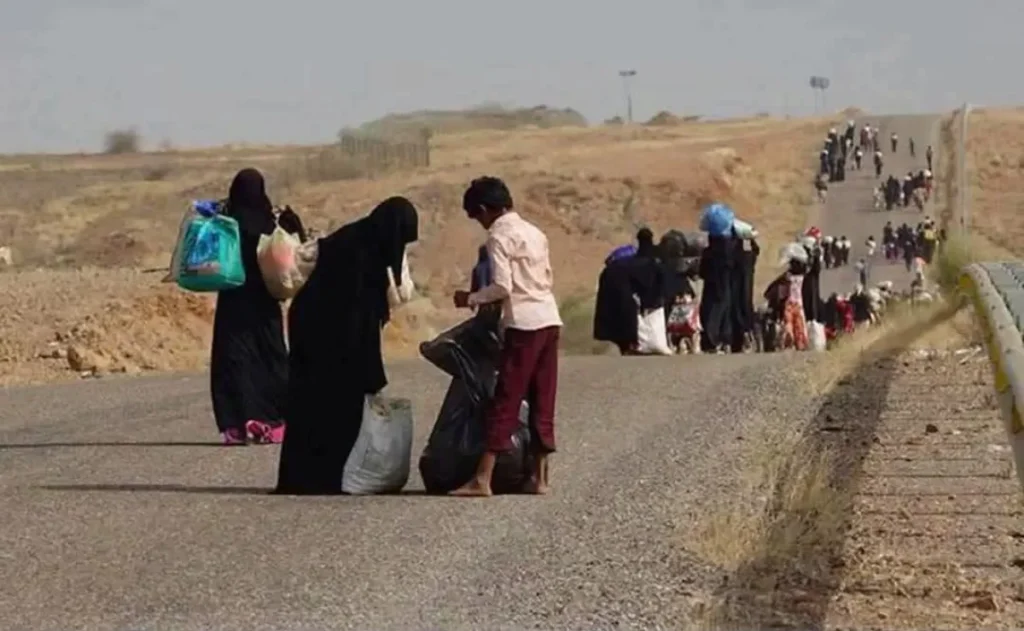
As military confrontations between government forces and Houthi fighters intensified on Taiz and Al-Hodeidah fronts, the number of civilians affected by military operations rose steadily. Last August, for instance, more than 100 families were displaced from their homes in Dhubas area, north of Hays District in southern Al-Hodeidah.
As the situation evolved and intensified, the number of people displaced from villages and rural areas increased, peaking on September 9. This increase coincided with the Houthis’ intensification of military operations, which led to the fall of towns and areas along the southern coast of Al-Hodeidah and in western Taiz, including Al-Mokha.
Official statistics indicate that the displacement wave included more than 23550 families, reportedly totaling at least 158000 displaced individuals, who faced one of the most severe and dangerous emergency displacements caused by the war. Officials from the government’s Human Rights Office in Al-Hodeidah reported that displaced persons, who had gathered along the coastal road leading to Aden, were subjected to rocket fire and drone attacks by the Houthis. These attacks resulted in dozens of casualties—estimated at more than 70 civilians, mostly women and children—according to preliminary figures.
In this context, local sources reported to Rights Radar that Houthi gunmen carried out an extrajudicial killing against a displaced family traveling to Al-Khokha during their breaking into the city of Hays, in the south of Al-Hodeidah Governorate, on September 9. The sources stated that the Houthis opened fire with a medium machine gun on a minibus carrying the family of engineer Abdulghani Razzah. The attack killed 15-year-old Khaled Abdulghani, his sister Marina, and their maternal grandfather, Hassan Abdo Saleh. In addition, the mother and two other children, Manal and Khalil, sustained gunshot and shrapnel injuries to various parts of their bodies; their conditions were described as critical.
In a separate incident in Hays on the same day, the Houthis targeted teacher Mohammed Omar Aqad and his son, Younis, with a drone while they were traveling by motorcycle along the Hays-Al-Khokha road to visit acquaintances in Al-Khokha, resulting in the death of both men.
Rights Radar has called on the international community, led by the United Nations and its Special Envoy for Yemen, Hans Grundberg, to pressure the conflicting parties in Yemen to refrain from targeting civilians and to protect them from the horrors of armed confrontations.
Also, Rights Radar has called for an impartial and transparent international investigation into the recent violations, as well as all violations committed since the outbreak of the current war in Yemen. In addition, the organization has called for those responsible to be identified and held accountable in order to prevent impunity and ensure the victims’ right to an effective remedy and reparation.